

The $250 Billion Opportunity
Why Serving America’s Underbanked Is the Next Economic Frontier

The Hidden Engine of American Commerce: A Call for Radical Inclusion
For too long, the narrative surrounding the “unbanked” and “underbanked” in the United States has been narrowly framed purely as a social problem—a lingering symptom of poverty and inequality. This lens is not only incomplete; it is profoundly misleading. It blinds us to a fundamental economic truth: The underbanked community in America is not a fringe group; it is a massive, dynamic, and economically vital segment of the population that collectively represents the next great frontier for innovation, investment, and growth.
This is not a policy brief designed for think tanks, but a strategic call to action for entrepreneurs, venture capitalists, and financial innovators. It is time to shift our collective perspective from viewing financial exclusion as a systemic failure to recognizing equitable inclusion as the largest, most undercapitalized market opportunity of our time. The failure of the legacy financial system to serve this population is not just a moral deficit; it is a demonstrable economic drag. By strategically unlocking the financial potential of the underbanked, we don’t merely achieve social good; we ignite hundreds of billions of dollars in new economic activity and create wealth where only fees existed before.
Quantifying the Exclusion - The Staggering Scale of the Market
Defining the Underbanked: A Market, Not a Minority
In the context of the US, the challenge of “financial exclusion” is deeply nuanced. As explored previously in “The Future of Banking Isn’t a Bank,” the critical issue is not the lack of absolute access, but the absence of equitable access to fair, transparent, and affordable financial services.
While attention is often paid to the 4.5% of US households that are completely unbanked (having no checking or savings account), the true scale of the market opportunity lies with the staggering 14.1% of US households that are underbanked. These are individuals who possess a bank account but are still forced to rely on high-cost, predatory alternative financial services (AFS) like payday loans, check-cashing outlets, money orders, and pawn shops to meet their most basic transactional needs.
The Magnitude of the Financially Excluded
Based on the latest data from the FDIC, the numbers are too large to ignore:
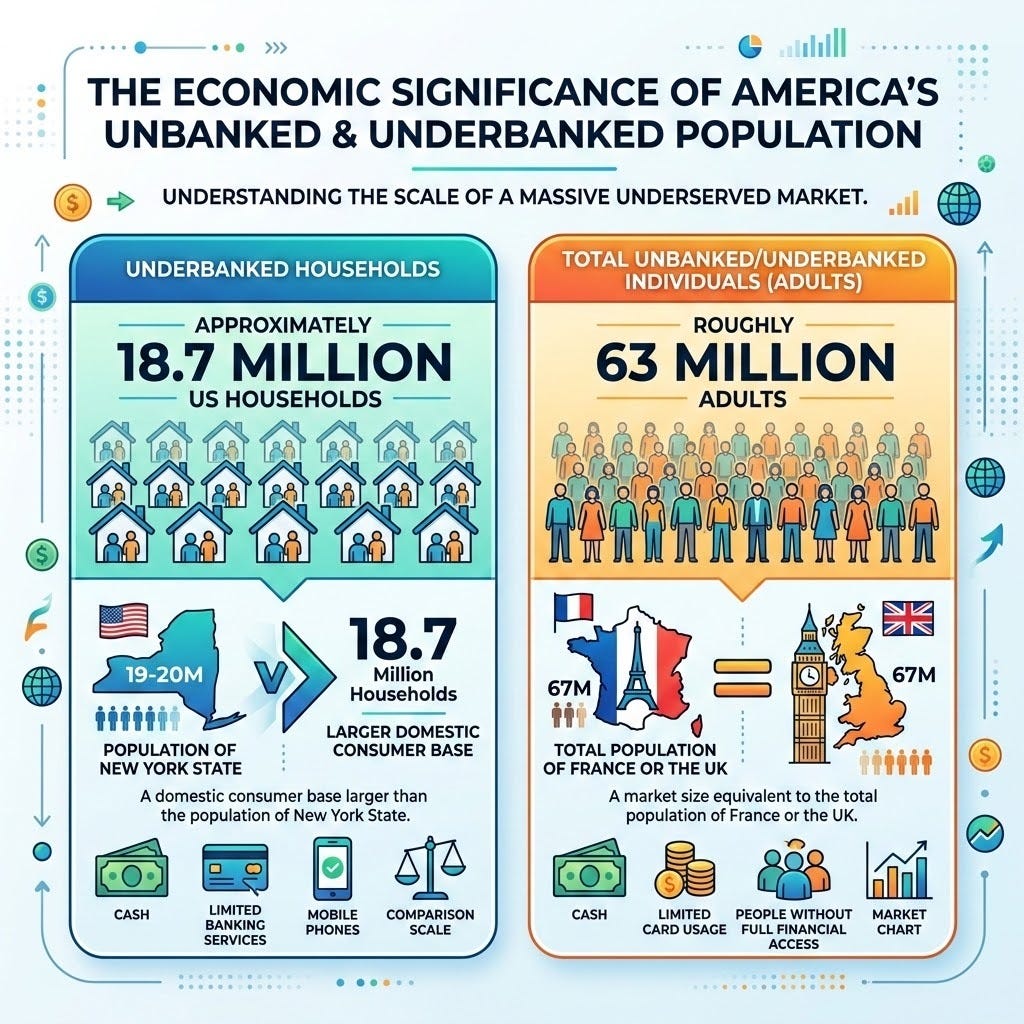
This is not an insignificant, niche segment; it is a major economic force whose financial lifeblood is currently routed through an astonishingly inefficient, exploitative, and technologically outdated parallel financial system.
The Economic Drain: The $250 Billion Leak
When individuals are systematically excluded from low-cost mainstream banking, they are forced to endure a financial toll—the “poverty penalty.” This is the excessive premium paid simply for the fundamental right to manage one’s own money, and it is where the magnitude of the opportunity—and the current economic tragedy—becomes acutely clear.
The Cost of the "Poverty Penalty"
The fees, interest, and penalties paid by underbanked consumers to AFS providers represent a massive annual transfer of wealth away from productive economic activity. Estimates consistently place this annual cost in the tens of billions of dollars:
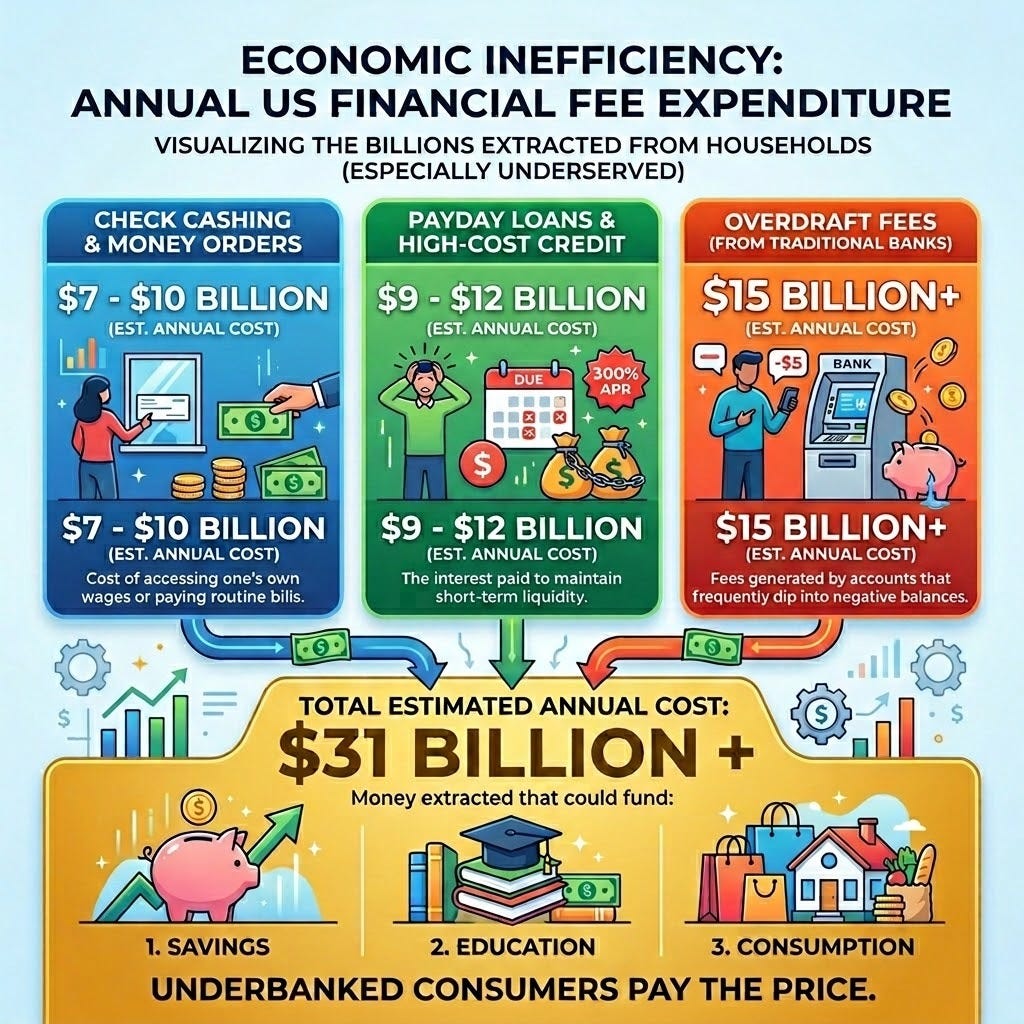
This $31 billion+ in annual leakage is a direct loss to savings, investment, consumption, and education—all crucial drivers of local and national GDP growth.
The Mechanism of Wealth Extraction
The “poverty penalty” is not a single transaction but a persistent series of extractions. Consider the compounding effect of these fees:
The Overdraft Cycle: For the underbanked who maintain a traditional account, overdraft fees often compound. A small purchase might trigger a $35 fee, which can then lead to subsequent purchases also incurring $35 fees before the user is aware or can deposit funds. These cycles can quickly cost hundreds of dollars, forcing the user back to AFS products to cover the bank fees.
The Check Cashing Premium: For a person earning a low hourly wage, having to pay 3% to 5% of their paycheck just to receive their funds means they are effectively paying an intermediary just to work. Over a year, this amounts to weeks of lost wages. This premium is unavoidable if the individual does not trust or cannot afford a traditional checking account.
The Financial Stability Cost: This $31 billion figure does not capture the secondary costs, such as the increased difficulty in paying rent on time, the inability to save for a security deposit, or the necessity of selling assets (pawn shops) at a fraction of their value—all of which perpetuate a state of financial fragility.
The Consumer Spending Power
Crucially, this community is not inherently poor; it is simply poorly served. Beyond the fees, the underbanked population possesses significant aggregate economic clout. While individual incomes may be lower than average, in aggregate, this community commands an estimated $250 billion in annual purchasing power.
Imagine the transformative economic effect if this quarter-trillion dollars were managed efficiently within a regulated, low-cost mainstream system. Freeing up that $31 billion annually for productive use would create an economic stimulus driven entirely by inclusion. This community is not asking for charity; they are demanding a fair market mechanism to manage their substantial economic contribution.
The Anatomy of Exclusion - Demographics and Debt Traps
A Deeper Dive into the Demographics and Use of AFS
To successfully innovate for this market, we must understand the systemic roots of exclusion. The underbanked are disproportionately concentrated in certain demographic groups, underscoring that financial technology must address underlying issues of historical inequity, trust, and physical proximity.
Demographic Breakdown of Financial Exclusion: A Statistical Inequity
The FDIC survey data consistently highlights stark disparities where financial exclusion is concerned:
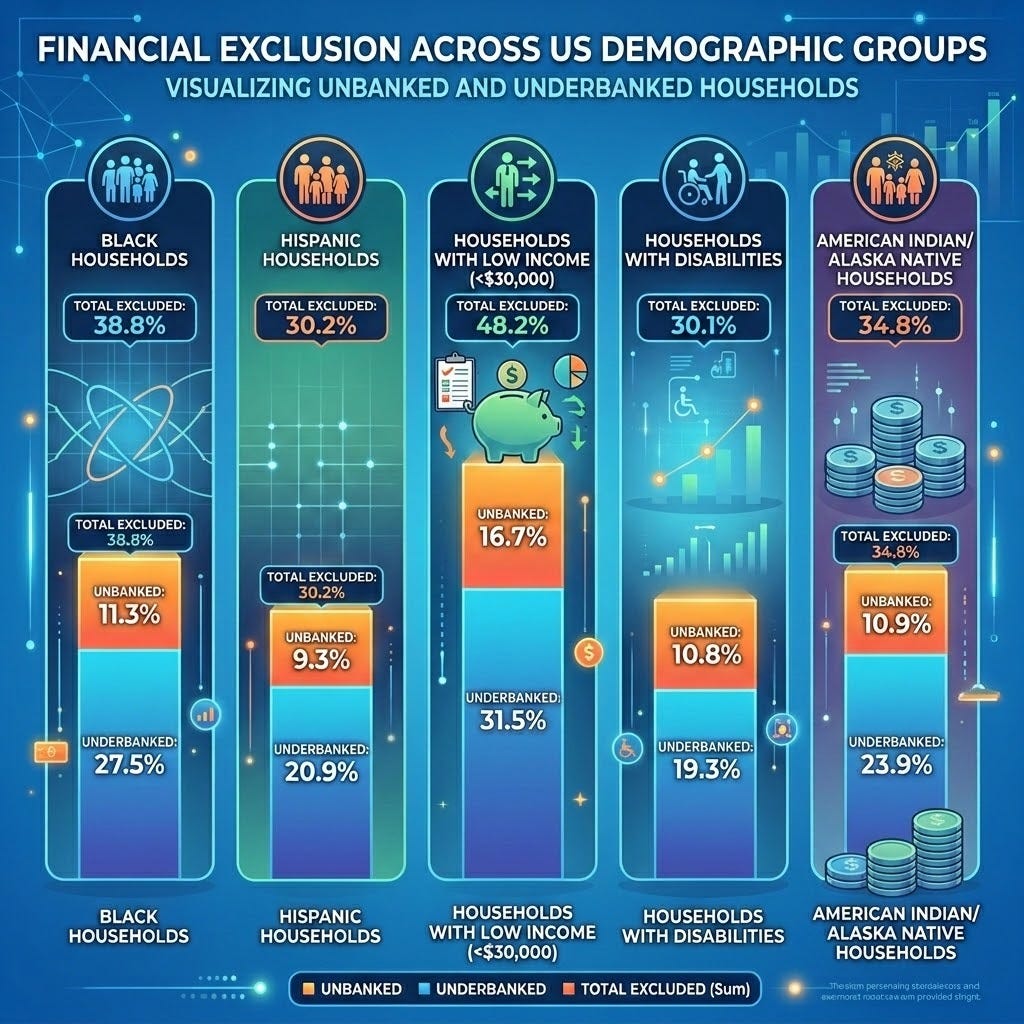
These statistics are not incidental; they are a mandate. Any successful solution must be culturally relevant, address historical barriers to trust, and provide access points that respect the lived realities of these communities.
The Financial Bleeding: Routine AFS Usage
For the underbanked, reliance on AFS is not a rare emergency—it is routine, high-cost necessity:
Check Cashing Fees as a Pay Cut: A significant portion of the underbanked still rely on paper paychecks. The typical AFS fee for cashing a check is 3% to 5% of the check’s value. For an individual earning $40,000 annually, cashing 24 paychecks a year at a conservative 3% fee results in an annual loss of approximately $1,200 just to access their own wages. This is an effective, non-negotiable pay cut that severely limits savings potential.
The Remittance Tax: When sending money internationally—a critical function for many households—AFS providers often levy flat fees coupled with a hidden exchange rate markup that can consume a whopping 5% to 10% of the principal amount sent. For immigrant communities sending money home to support their families, this “tax” is a crippling inefficiency. A Web3 solution that uses stablecoins could reduce this cost by an order of magnitude.
Money Order Dependence: Over 10 million US households use money orders routinely to pay bills or send rent. While seemingly minor, the recurring fees—often $1.50 to $5.00 per order—quickly compound to represent a major, non-bankable transaction cost simply to meet contractual obligations.
This continuous, routine extraction of wealth acts as a permanent barrier to capital accumulation and upward mobility for these communities.
The Anatomy of the Payday Loan Trap
The most devastating AFS product is the payday loan, engineered for dependency.
Annual Users: An estimated 12 million Americans use payday loans every year.
Average APR: The average annual percentage rate (APR) on a typical two-week payday loan is a stunning 400%.
The Debt Cycle: The average borrower takes out 10 loans per year, spending approximately $520 in fees to borrow $375 repeatedly. This is a product engineered for entrapment, where the fees often exceed the principal amount borrowed, year after year.
The existing system struggles to provide the immediate liquidity that is urgently needed. Web3, however, is uniquely capable of solving this problem by offering instantaneous and cost-effective liquidity solutions.
The Web3 Imperative - Building the Inclusive Infrastructure
The traditional banking system has demonstrably failed to absorb this market. Why? Because the existing infrastructure is not economically viable for low-to-moderate-income (LMI) consumers. Traditional banks are optimized for high-balance accounts and punitive fee generation, viewing LMI accounts as high-risk and low-margin.
This failure creates a vacuum that the principles of Web3—decentralization, borderless trust, and disintermediation—are perfectly suited to fill, offering solutions that go far beyond incremental fintech improvements.
1. Eliminating the Predatory Fee Structure
The core value proposition of a Web3-powered financial infrastructure is the potential for near-zero-cost transactions, directly disrupting the AFS market:
Decentralized Payment Rails: By leveraging stablecoins and high-efficiency blockchain rails (like Layer 2 solutions), the transaction costs for cashing checks, processing remittances, and paying bills can be reduced from dollars to mere pennies. This directly undermines the business model of check-cashing and money transfer services, routing the $7-$10 billion in check cashing fees back to consumers.
Smart Contract Escrow: Escrow services, traditionally requiring costly intermediaries and complex legal frameworks, can be automated via secure smart contracts. This provides transparent, nearly free mechanisms for essential transactions like rent payments, security deposits, and peer-to-peer lending, thereby building trust without needing a centralized authority. The automation drastically lowers the barrier to entry for secure financial agreements.
2. Building Credit Through Data, Not Debt
The most insidious form of exclusion is the credit score crisis. Millions of Americans pay rent, utilities, and phone bills reliably month after month, yet this data remains invisible to the major credit bureaus. This locks them out of prime lending rates and pushes them toward high-interest debt traps.
The Statistical Reality of the Credit Invisible
Credit Invisibles: Approximately 26 million US adults are “credit invisible,” meaning they have no credit file whatsoever.
“Thin File” Consumers: An additional 19 million US adults have “thin files” with too few accounts to generate a reliable FICO score.
The Economic Cost of a Low Score: Lacking a prime credit score can increase the interest rate on a standard 60-month, $25,000 car loan by 10 percentage points or more, often costing the consumer thousands of dollars over the life of the loan.
Web3 offers a paradigm shift:
Decentralized Identity (DID): A self-sovereign identity system allows individuals to securely control and permission their own verified financial data (e.g., rent payment history, utility records, job tenure). This identity is portable across platforms, liberating the consumer from the confines of centralized reporting agencies.
On-Chain Credit Scoring: New Web3 platforms can analyze this verifiable, permissioned on-chain behavioral data (such as DID-verified utility payments or consistent micro-savings) to create alternative credit scores. This enables access to fair lending that is collateralized by verified behavior rather than existing wealth, fundamentally democratizing credit access. The transparency of the blockchain can also provide a clear, immutable record for lenders.
3. The Power of Real-Time Liquidity and Micro-Savings
The need for short-term liquidity is what drives millions to the high-APR payday loan industry. Web3 infrastructure offers an elegant, disruptive alternative:
Earned Wage Access (EWA) on Chain: Web3 rails enable real-time payroll, allowing employees to access wages as they are earned (tokenized EWA). This eliminates the need for predatory short-term loans entirely by providing liquidity at the moment it is required, not just on a bi-weekly schedule. By disintermediating the payroll process, a significant source of financial stress is removed, directly combating the $9-$12 billion spent on high-cost credit.
Automated Micro-Savings: By seamlessly integrating savings mechanisms directly into payment streams (e.g., rounding up purchases into a yield-generating stablecoin protocol), users can passively and automatically accumulate small amounts of digital currency. This moves users from a state of perpetual financial fragility to genuine resilience, turning transaction costs into micro-investments.
The Investment Thesis - An Inclusion Multiplier
The opportunity to innovate for the underbanked is not a small market niche; it is the chance to build the foundational economic infrastructure of the 21st century.
Market Validation and the Web3 Opportunity
The success of traditional fintech companies like Chime—whose astronomical valuation was driven by targeting the fee-averse, underbanked demographic with low-cost, user-centric banking—clearly validates the massive market appetite. Chime proved that this market wants to engage with financial services that treat them fairly. However, these models ultimately remain reliant on the slow, expensive rails of the legacy banking system, and often still utilize overdraft-like mechanisms, limiting their truly transformative power.
The Web3 opportunity is to create true financial independence—a system where services are delivered at cost, not an inclusive front-end for an extractive back-end. This is a chance to move beyond incremental change to systemic disruption.
Investment Thesis: High Returns, High Impact
For venture capital and angel investors, the thesis is clear: Investments in financial inclusion platforms generate both high returns (by capturing market share from AFS) and high social impact.
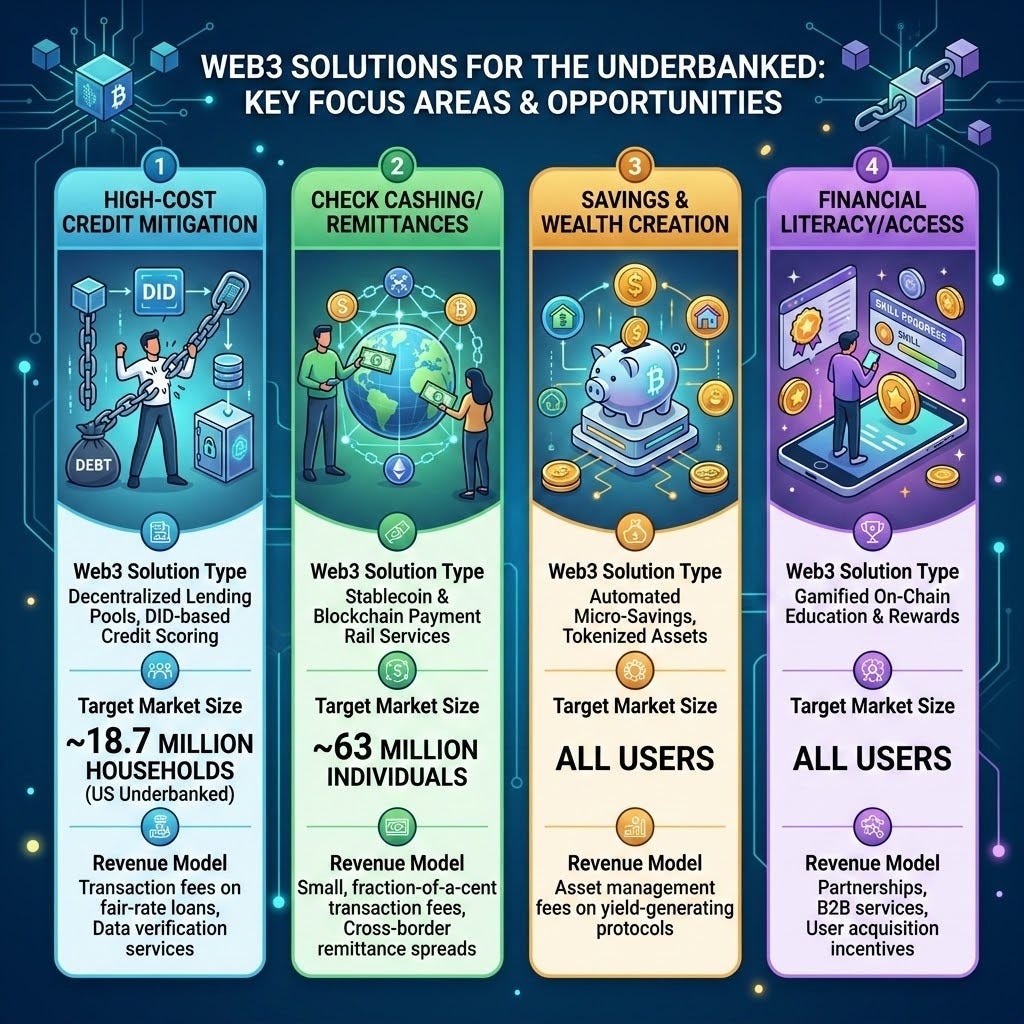
The Societal Returns: Beyond the Balance Sheet
The $250 billion in purchasing power and $31 billion in fee savings are compelling, but the broader societal returns of true financial inclusion are transformational.
Reducing Economic Fragility: Research shows that nearly 60% of Americans cannot cover a $500 unexpected expense. For the underbanked, this figure is higher, meaning a small financial shock (a car repair, a sick day) immediately triggers a debt spiral. Web3 platforms can build resilience by generating low-cost liquidity and incentivizing automatic savings, creating a societal buffer against sudden poverty.
Boosting Local Economies: The $31 billion extracted by the AFS industry is wealth that leaves local communities and flows to large corporate entities. When this money is saved, invested, or spent locally—on education, housing, or necessities—the economic multiplier effect directly stimulates local GDP and community stability. This is a profound shift from extraction to circulation.
Reducing Inequality: By democratizing access to credit and wealth-building tools (like micro-investing and fractional ownership of assets via tokens), Web3 inclusion initiatives directly combat systemic wealth gaps rooted in historical financial exclusion.
The Path Forward—Regulation and the Entrepreneurial Mandate
The US regulatory environment, while cautious, is moving toward recognizing the imperative for innovation that enhances consumer protection. Web3, paradoxically, can be the most compliant and consumer-safe system ever created.
The Alignment of Web3 and Regulatory Goals
Consumer Protection by Design: Solutions built on smart contracts for lending or escrow inherently feature transparency and automated compliance. The rules are code, immutable and visible to all parties, offering a higher degree of protection than opaque AFS agreements. Regulators seeking transparency should embrace this immutability.
Stablecoin Utility: Increasing regulatory clarity around stablecoins reinforces their utility as the ultimate low-cost, real-time replacement for high-fee money orders, wire transfers, and slow interbank settlement systems. A regulated stablecoin is a public good for the underbanked population.
Data Sovereignty (DID): Giving users control over their financial history via Decentralized Identity (DID) aligns perfectly with growing governmental mandates for data privacy (like GDPR and similar state-level efforts), while simultaneously unlocking new credit opportunities. This shifts power away from centralized data monopolies.
Strategic Partnerships for Scale
To successfully onboard the 63 million financially excluded adults, Web3 companies cannot operate in a vacuum. Scaling requires strategic, localized partnerships:
Payroll Providers: Integrating EWA tokenization directly into major payroll processors is the quickest route to mass adoption and the direct disruption of the payday loan industry.
Retail/Physical Infrastructure: Developing simple crypto on/off-ramps via established retail networks (drugstores, corner markets) allows users to easily convert cash into stablecoins or digital currency. This replaces the check-cashing window with a decentralized, lower-cost alternative.
Non-Profit and Community Banks: Partnering with CDFIs (Community Development Financial Institutions) and local non-profits builds essential trust within the target demographics and provides compliant, physical touchpoints for digital education.
The Entrepreneurial Call to Action
For those looking to build the financial infrastructure of the future, the focus must be on three essential, user-centric solutions:
Painless Fiat On-Ramps: The complexity of crypto must be invisible. Develop simple, highly accessible methods for converting fiat currency (paychecks, government benefits) into spendable digital currency or for utilizing low-cost digital payment rails. This requires strategic partnerships with existing retail networks, drugstores, and payroll providers.
Affordable, Algorithmic Liquidity: Replace the 400% APR payday loan with truly fair, algorithmically driven short-term credit solutions. These solutions should be backed by verifiable on-chain assets or tokenized future earnings, making credit a utility, not a debt trap. The key is automation and low-interest rates derived from efficient smart contract risk assessment.
Credit Builder Products: Create services that automatically translate recurring, responsible economic behavior - like timely rent or utility payments - into verifiable, on-chain credit history. Design apps that automatically link user DIDs to these credentials, enabling them to bypass the traditional FICO gatekeepers and gain access to mainstream financial products.
The company that successfully captures even a fraction of the $250 billion purchasing power of the underbanked will not just be a billion-dollar company; it will be a foundational pillar of the 21st-century American economy.
Conclusion: The Defining Mission
The underbanked in the US are the largest, most critical, and most financially exploited market in the nation. This community, consisting of 63 million adults with $250 billion in spending power, is currently subsidizing the profits of a predatory industry, suffering $31 billion+ in punitive fees annually.
The broken legacy system is an unambiguous indicator that the market is ripe for disruption. The transition from a “walled garden” banking model to an “open network” built on decentralized principles is the only way to equitably and sustainably serve this massive community. For the visionary entrepreneurs and investors who choose to dedicate their resources to this mission, the financial and societal rewards will be immense, proving that the future of finance is inherently inclusive, and the greatest fortunes are built on solving the greatest systemic problems.
Footnotes and Data Sources
The Future of Banking Isn’t a Bank: (Refer to my previous article context.)
Underbanked and Unbanked Statistics (FDIC): The latest data on unbanked and underbanked households in the US, including demographic breakdowns. Source: Federal Deposit Insurance Corporation (FDIC) – How America Banks: Household Use of Banking and Financial Services
Cost of Alternative Financial Services (Poverty Penalty): Estimates on the annual costs paid by underbanked consumers for check cashing, money orders, and high-cost credit. Data draws from research by the Consumer Financial Protection Bureau (CFPB) and various non-profit reports. Source: Consumer Financial Protection Bureau (CFPB) reports on short-term lending and prepaid cards
GDP Growth and Financial Inclusion: The positive correlation between boosting financial inclusion and GDP growth. Source: IMF (International Monetary Fund) articles and reports on financial development
US Household Population Data: Total number of households in the US used to calculate the absolute number of underbanked households (14.1% of US households). Source: U.S. Census Bureau – Families and Households
Overdraft Fee Revenue: Data on the banking industry’s reliance on overdraft fees, which disproportionately impacts underbanked consumers. Source: CFPB Study Finds Banks Continue to Rely Heavily on Overdraft and NSF Fee Revenue
Credit Invisibles and Thin Files: Statistics regarding the number of US adults with no or thin credit files. Source: Consumer Financial Protection Bureau (CFPB) – Data Point: Credit Invisibles
Payday Loan Usage and Cost: Specific data on the average APR, usage rates, and total fees paid by payday loan borrowers. Source: Pew Charitable Trusts – Payday Loan Facts and the CFPB’s Authority
Financial Fragility (Emergency Savings): Statistics regarding the percentage of Americans unable to cover a $500 unexpected expense. Source: Federal Reserve Board – Report on the Economic Well-Being of U.S. Households